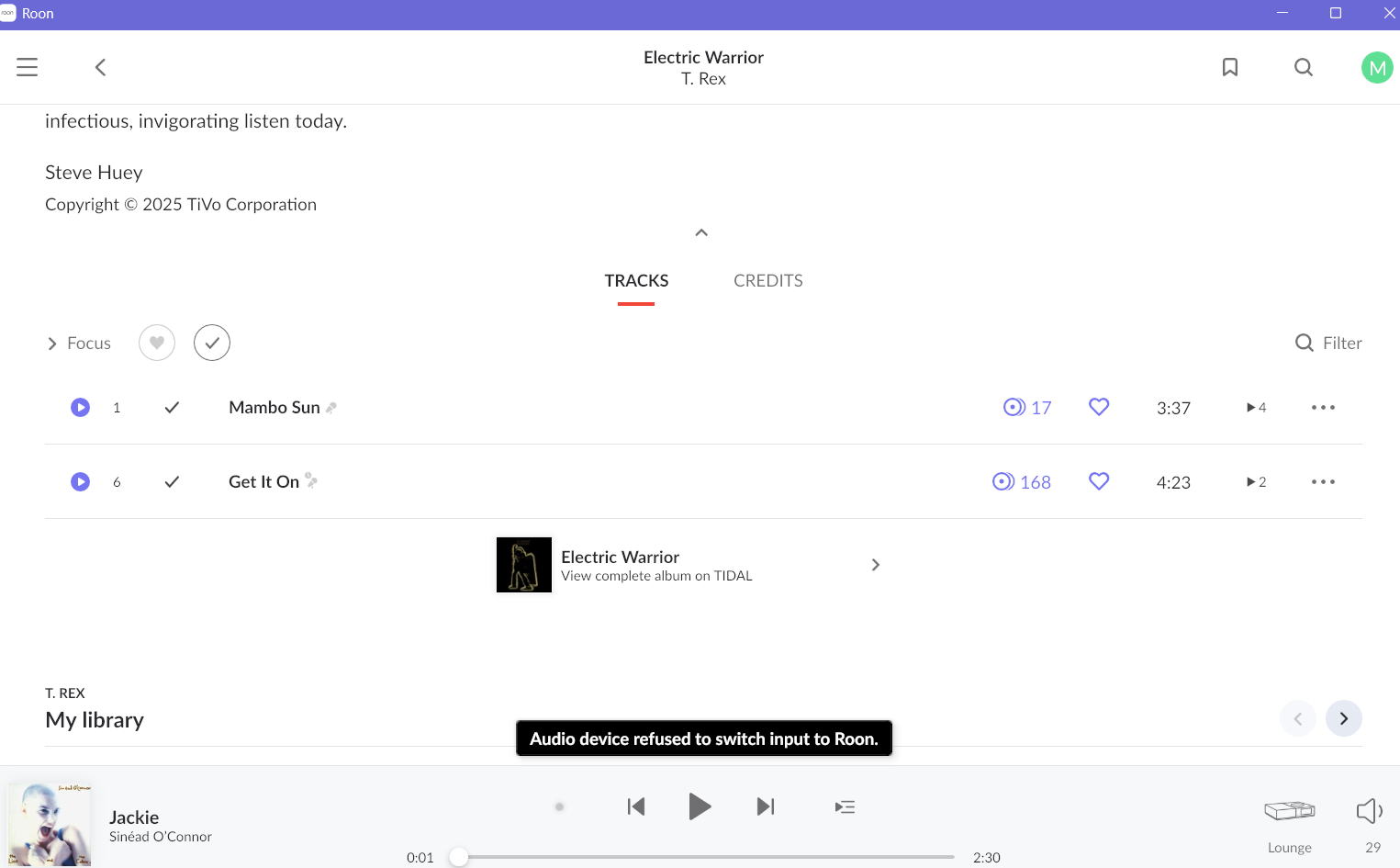
Thank you for your post. Ensure that the Naim Star, Muso, and Nova are all on the latest firmware and that input auto-switching is enabled if available in that firmware.
I’d double-check to ensure that a recent RoonServer or Windows update hasn’t defaulted any network security settings in your Defender firewall or third-party network security/antivirus software you might have installed on this machine. Specifically, you want to ensure RAATServer is exempted as a background network process.
We see RAATServer’s attempts to create a session with the Naim devices timing out, but RAAT also appears to time out when launching sessions with the local drivers for the System Output Zone.
If the Naim Zones continue to display this error, power cycle both RoonServer and the Naims, in that order, to trigger a device discovery cycle and clear the input.
Hi Connor,
Thanks for your feedback. Not sure that the initial questions asked in the questionnaire clarified that the Roon used to work with all three devices until a few months ago and then it became intermittent. But the last few weeks/month the server seldom loads and when it does I get the message noted in the screenshot.
I have checked the firmware for all three and only the Star required an update.
As far as I am aware no windows updates have occurred, but sometimes these happen overnight.
The antivirus is the same as before and has been running since last September. How would I know what the windows default settings are, or should be to be compatible with roon?
I have no idea what RAATserver is and where to find it, or is that a typo and you meant RoonServer?
What do you mean by “power cycle both RoonServer and the Naims” Do you mean turn them off and on at the mains, or is there some specific routine you are referring to?
Hope the above helps
Regards
Mike
One other issue is that the other laptop cannot find the server at all, but is on the same network.
Hi @mike_scott,
Thanks for getting back to us with all of these details.
Did the Star restart after the firmware update completed?
RAATServer isn’t a typo; it’s a core part of how Roon communicates with audio devices. It must be allowed through your firewall for everything to function properly. This article shows you how to check and add exceptions in your firewall. Please also confirm that your Windows computer is set to use a Private network profile instead of a Public one.
Yes, by power cycling we mean turning off the device, unplugging it from power for about 10 seconds, and then plugging it back in and turning it on. This helps clear temporary network or software issues.
Let us know how it goes after checking these things.
The Naim Star did restart, you have me slightly worried why it wouldn’t!
Regarding the RAATserver, I got as far as trying to select the app to pass the firewall, but had to give up on that, as that option was greyed out as an option.
So I went for the final option of unpluging the audio device.
Conclusion, I assume the old turn off turn on at the mains worked, as I have managed to reconnect to the server and the Naim isn’t rejecting roon from the laptop.
The only issue I now have is that the laptops that are not the roonserver cannot find the roonserver, yet they are on the same network?
Great to get it working on the main Naim Nova, so thanks for that, but if you have any suggestions for accessing the Roonserver from the other laptops would be appreciated, so we can then use the Muso and Star in the other rooms.
Can you please provide more information on the exact symptoms you are seeing with the laptops? Are they stuck on the “Choose your Server” screen? Have you ensured that you are not using a public network and are using private network for the laptop network settings as per @daniel 's previous post?
I am afraid the problem is back again, in that the laptop that holds the server, cannot actually find the server, even when it is running, or roon launched from the Server icon. This is the same on the other laptops, except they have no server icon to try the launch, just the usual Roon app. Neither find the server that clearly states that it is running, but the only suggestion/option is to select another server, which of course there are no others to select.
Being a Virgin Media user myself I think this could be a case of 2 separate SSID’s being present.
Do you see 2 VM WiFi network names similar to this when you search for a WiFi network?
VM123456 (this being 2.4ghz WiFi)
VM123456_5g (this being 5ghz WiFi)
It’s been a while since I used my Hub4 as the router but I’m sure they come setup like this.
If this is the case I think your Roon Server is on one of your WiFi SSID’s and your equipment are on the other. Via the Hub4 settings you can join these to be one SSID.
Hi Mr Flibble,
Thanks for the feedback. I understand your approach, as the earlier Hub3 or 2, used to split the network into the 2.4 and 5hhz, but the Hub 4 is a combined network.
The bizarre thing is, the server and the main access roon app are on the same laptop, yet the server can be running and the app cannot find it!
There have been many reboots, or “power cycling” as it now seems to be called. Turning the Naim on and off did work for one day and then it lost synchronicity again!
There must be something that I am missing in the functionality, set up etc. But then why is it so inconsistent, working sometimes and mainly not others!
Can you please confirm the name of the laptop affected by this issue? I see you have two Roon Servers registered to your account and I’d like to enable diagnostics for the correct one. Is it Mike-Mobile or Office-Asus impacted?
This typically happens when there is a firewall in place, preventing proper communication between the Roon Server app and the Roon UI app.
Regarding which laptop has the server, it is Mike Mobile. I had to swap due to different problems running roon from the static laptop located in the office.
I can confirm that the networks are set as private.
Thanks for the follow-up, it looks like your devices haven’t reached our servers in 5 or so days - as a next step, I’d look at simplifying your network topology as much as possible.
Can you get a direct ethernet connection from your Windows machine running Roon Server directly to your primary router? Reboot both the router and your Windows machine, and see if you’re able to connect - we’ll attempt to enable diagnostic mode for your Roon Server as well with the hopes that it connects with our servers.
Let me know if this is possible and if you have any additional questions!
Hi Benjamin,
I will have a go at connecting the laptop with the server to the router direct. But this will have to be over the weekend.
I assume you therefore believe the wifi is the issue. I can think of a few ways around this, mainly being, or the only one I can think of, would be setting up an old laptop that is permanently plugged into the wifi. But then do we still not have a wifi issue for controlling the output?
Wi-Fi is definitely more susceptible to interference than ethernet. Even if you can’t remove Wi-Fi from the entire signal path, reducing its role—especially between the core and endpoints—can make a noticeable difference. Let’s see what you find over the weekend and we’ll take it from there.
Hi Daniel,
Sorry for the delay in responding, but I did have a go at plugging the server direct to the router and there was no difference in how the application spent circa 5mins + trying to find the server. When it does find it, it lasts for maybe a few minutes, if at all and then complains it can’t find it again.
Even when it does find the server and stays attached, it cannot find the Naim appliances and then when it has about got over that problem, it loses the server again.
Tonight there has finally been some success finding both server and amp, but the delay in getting to this stage is just poor and cannot be the norm, something is not right.
Thanks for the feedback and I do have an update, in that the roon app on the laptop holding the server is now more consistently finding and opening the server, so the system can be utilised.
I having been leaving the roon app open permanently with a connection to the server, to try and get the other laptops or phones used in the house to connect, but this is still remains an issue.
The laptop server and player is the only functioning unit. Your suggestion of disabling the firewall on the server laptop, is still not allowing other devices to access the media.
The goal is to try and have the three Naim devices playing either independently, or in some cases the same. But at the moment, the devices can be seen in the list from the server laptop, but any other access device, laptop or phone used hardly ever finds the server. I think it has picked it up maybe 2 or 3 times in over a year.
Thanks for the follow-up! We took another look at a fresh diagnostic report from your Roon Server, and saw multiple connectivity errors in relation to the Naim devices, as well as other remotes, for example:
We’d like to review potential settings on your router that may be causing these blockages in connection.
First, let’s see if we can Disable Smart WiFi / Channel Optimization on your Hub4. Virgin’s “Smart WiFi” can cause Roon endpoints to drop or fail discovery due to band steering or roaming.
Steps:
Go to 192.168.0.1 in a browser (the default IP of the Hub 4)
Login with your router admin password
Navigate to Advanced Settings > Wireless > Smart WiFi
Turn off Smart WiFi / Channel Optimization
Optionally, split the 2.4GHz and 5GHz bands into separate SSIDs (this helps avoid devices flipping between them)
If you still have issues - let’s make sure client isolation is turned off:
Virgin’s firmware doesn’t expose this setting directly, but switching off "Wireless MAC Filtering" or "Guest Mode" helps.
Ensure all Roon devices are on the same subnet and connected to the main Wi-Fi network—not guest Wi-Fi.
I’d also check and disable any ad-blocking DNS settings or Parental Controls on the Hub 4 that may block necessary Roon domains.
Hi Benjamin,
Sorry for the delay in responding, but it has been a busy period.
I have logged in to the router and turned off the channel optimisation, but this made no difference the server could still not be found, even on the laptop it is located.
The client isolation is already turned off.
The effect of the changes suggested do actually have an impact on other devices, with printers not being found etc. So as there has been no success finding the server, or audio devices I have had to revert the changes.
As a further note, in case it helps, but when Roon does find the server, many of the tracks noted in the database state that they are unavailable, yet they are in the NAS drive that can be found from the same laptop. I can also use Tidal over all the audio devices.
It is frustrating, actually, very frustrating and such a waste of time trying over and over again to get the various components to work.
The key issue remains, in that it seems to be the server not wanting to be recognised and when it is, then refuses to find both the audio database and the various players!
We’re seeing the Naim Unity Nova show up in your Roon Servers device announcements quite frequently, potentially more than normal, and it could be interfering with upstream connections. If you temporarily power this (and any other Novas you have) completely off and attempt to connect, how do things perform?
Outside of the above, we’d next like to take a closer look at the machine settings on your Windows 11 running Roon Server. Were you able to test out using a different machine as a temporary server?
For your current Windows 11 - what are some of the machines power settings set to?
Can you review: Advanced power settings > Processor power management > Minimum processor state (Aggressive power-saving may slow down background services)
If the PC is always on and expected to run Roon Server reliably, it's best to use the “High Performance” or a custom power plan with all sleep/power-saving options minimized or off.