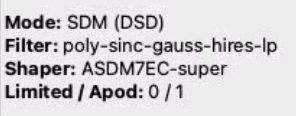
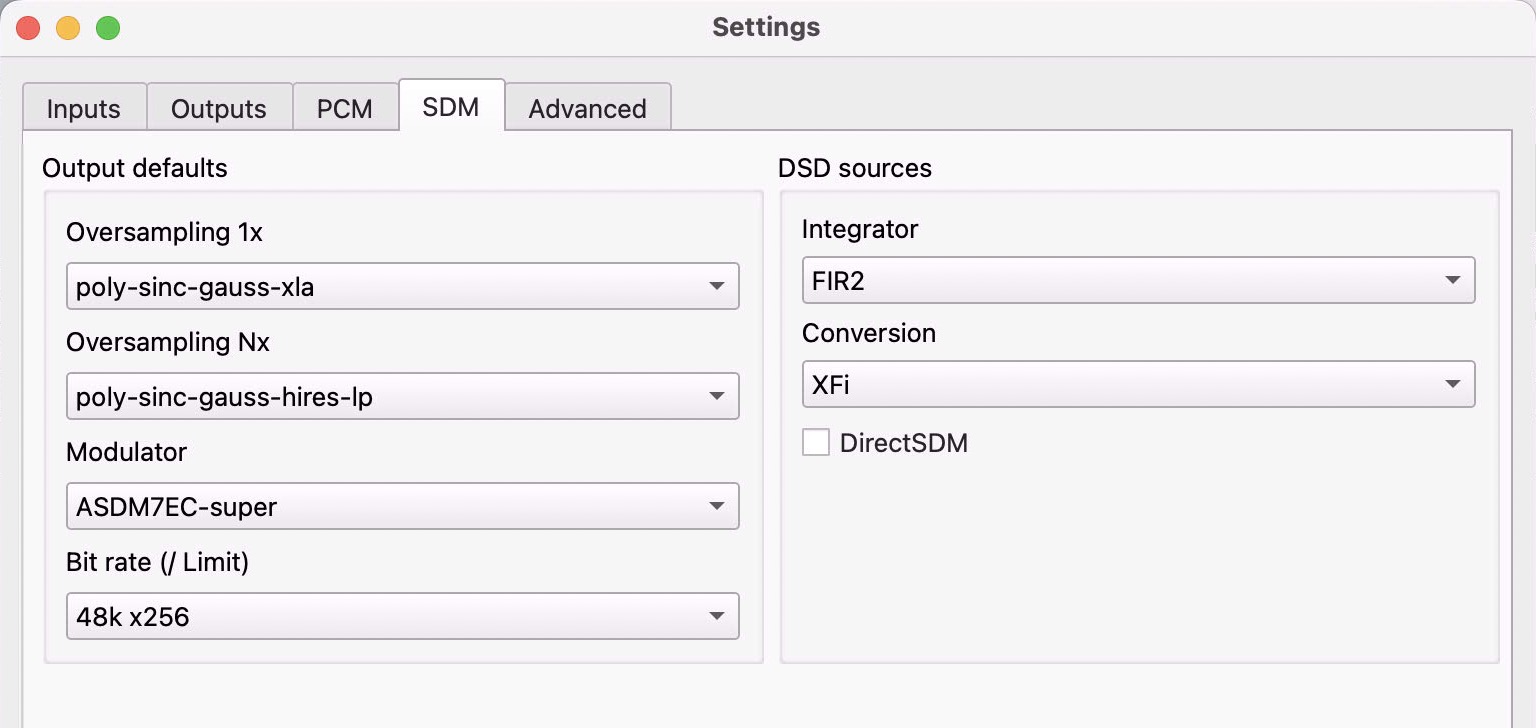
I have previously quickly written off the -super modulator as sounding too distant from me and, most importantly, a bit bloated, as if its aim was to try to wow you as opposed to present a fully cohesive sound.
Whilst I still mostly find this to be the case, I need to add a caveat to this, having re-visited this modulator today. Whilst it sounds bloated with the majority of my filters (gauss-xla, sinc-MGa), it actually sounds pretty amazing with poly-sinc-gauss-long which I’ve always loved for its realism and the magical cohesion between individual sounds. The main reasons why I’ve mostly preferred the -xla version is that it offers a bigger soundstage, has some more kick to it and is not so in-your-face. The last factor can be quite annoying for me in the -long filter as some intimate recordings sound as if some of the sounds originated in my head. I love intimate presentation (when called for) but I hate this sensation of the soundstage starting in the centre of my head. The -xla filter fixes that.
Well, none of those issues appear to be present when the -long filter is used with the -super modulator. And, ironically, what appeared as “bloated” in the other two filters, now just gives the -long filter what it was previously missing (to a small degree). The soundstage being pushed slightly further away fixes the “overintimacy” issue. And the extra punch that the -super modulator has works perfectly with the -long filter also.
I’ll need to do more listening but at least on certain recordings the -super modulator with the gauss-long filter might quite possibly be the best thing I’ve heard so far. It makes me wonder if the -super modulator fixes the -long filter’s shortcomings by overdoing certain aspects of sound (then it’s simply a matter of synergy) or if the -super filter is actually so much technically better than the standard version that it allows the -long filter to show its true colours (whilst exposing the even longer filters for their “bloatedness”).
@jussi_laako I appreciate that you might not want to reveal too much about your modulators but it’d be great to know if your main aim behind the -super filter was to make it as perfect as possible or to simply make it sound different than the others (thus giving us more choice, depending on people’s preferences).
Really enjoy reading your reviews! Very insightful and informative. I’ve been switching back and forward from filters and modulators and on different DACs is always new an nice listening experience!
My design is always based on objective goals. I have strict objective goals for everything. Once I reach the objective goals, I start listening. If something seems to be off, I find objective reasons behind it and rework until all goals are met.
light/super is kind of fresh start from what I’ve known before and also new things I’ve discovered along the way to the date. “What if I would make a new one, how would I do it now?” kind of thing. I also wanted to give two clearly distinct ones, the regular and the 512+fs one.
My listening testing baseline is 1x=poly-sinc-gauss-long Nx=poly-sinc-gauss-hires-lp, I consider these filters as generally the current best middle-ground for all the different aspects. Like center point of the gravity.
I could also see in the way, that getting the modulator as correct as possible from all the aspects (it is mathematically very complex animal), will give also the most accurate sonic representation of the filters as well.
So it is not about making something sounding different, but just that something ended up sounding different based on the set of specific objective goals.
It is interesting to hear about how others hear these modulators and compare it to my initial impressions!
That’s useful - I assume that’s the actual schematic for the Tambaqui, not just a generic schematic for a Sharc-based DAC? I’d not been sure how a DSD stream was dealt with, so it does start to look as though HQP will make less of a difference on this DAC.
That said, out of the box it is the best sounding DAC I’ve ever heard.
SHARC is just a general purpose DSP processor from Analog Devices. There’s no such thing as generic SHARC based DAC. Just like there’s no generic Apple M1 based DAC.
Yesss. I do get that, really. The schematic however shows a chain of which the Sharc is only a part, hence my question. But never mind, I’ll bail out of this pedantry spiral and just enjoy the bloody thing, like an actual human being!
So most useful combination of Mola-Mola with HQPlayer is to set HQPlayer output maximum PCM rate supported by the DAC. Which should bypass those two 2UP sections from the diagram.
Interesting HQP 5 combo for (DSD256) Spring 2 > DNA Stellaris > ZMF Atrium: denser, punchier, very detailed. Too much of a good thing? Not sure, need a bit more experimentation.
The Tambaqui has a really awesome sigma-delta modulation stage that’s quite unique, if you’re technical you can read about the design here: https://www.researchgate.net/publication/277792005_Simple_Ultralow_Distortion_Digital_Pulse_Width_Modulator
The PCM stage that upsamples to 384Khz PCM has a leaky “slow” filter (which Bruno said sounded best during design). Bypassing that with HQPlayer’s high quality PCM filters will already give you quite a nice performance uplift, as the first upsampling stages matter the most. As Jussi said feeding the Tambaqui DSD is probably inferior. One advantage here is that since the computational workload of this is so low you could even do it with a passive NUC.
Then there must be something strange going on with higher rate PCM inputs inside the MolaMola. (there are certainly couple of DACs out there that are not fit for use with HQPlayer)
Thanks very much for the explanation, @jussi_laako I know very little about the maths involved in this but it’s interesting to learn about your philosophy when designing different modulators. It helps me understand the processes involved in chasing this rabbit, so to speak.
That makes perfect sense but that also seems to imply that some modulators are more “correct” than others. I imagine that this simpy boils down to them overall having fewer trade-offs - I’d hazard a guess that the “super” ones are called so for a reason.
It’s so easy to love the -xla filter It does nothing wrong to my ears. The -xla for “experiencing” music as a spectator and the -long filter for being put right in the middle of it - I could happily live with just these two forever (-xla being the go-to one). Shorter filters (for Redbook files) don’t have sufficient space (soundstage) to my liking and the crazy-long ones seem to lose the “immediacy” that is so addictive with these two.
Looking at your screenshot I realised that I hadn’t actually tried the 7EC-super modulator and jumped straight to the 512+ version as I’m currently using DSD512. I wrongly assumed that any potential audible differences between them would be negligible. Now I see that there are differences and they were in fact intentional, with Jussi saying that they were intended to be “clearly distinct ones”.
Well, back to the drawing board for me; this 7EC-super has my attention now, that’s for sure. My very preliminary impressions are that this might just make my DAC sound the best it’s ever sounded. By comparison, the 7ECv3 sounds less punchy, more shouty, more “raw” (as opposed to “polished” - perhaps it’s to do with being a bit more shouty) and more intimate.
The 7EC-super sounds more like the 512+ version but (and it’s a big but) without the “bloatedness” (I can still hear it and I don’t like it - it’s not easy to make my Focal Utopia sound bloated as it’s got no boost in the bass area, but something triggers it with this modulator) and ever so slightly less distant (but not as intimate as the 7ECv3). It appears to be so good that for the time being I can’t see myself going back to either of the two other two (although it’s worth mentioning that nothing beats 7ECv3 + gauss-long for being put right in the middle of music, if that’s someone’s cup of tea).
At the moment, the 7EC-super modulator is for me the modulator equivalent of the -xla filter - there might be better options for a particular result but as a full package they seem to do nothing wrong and a lot unbelievably well. Looks like plenty of sleepless nights for me in the near future
I don’t have any experience with this DAC, but it sounds to me like it applies its own filters regardless of what sample rate it receives. The reason why I think this might be the case is that when I switch the NOS mode off in my Gustard X26 Pro, it sounds either roughly the same or possibly even worse (I’d need to check, it’s been a while since I last did this) than when not using the HQPlayer at all. I guess the DAC applies its own filters on top of the signal already upsampled by HQPlayer. And that’s not a good result.
When I switch the NOS mode back on again, it’s a completely different story - HQPlayer puts the DAC in “beast mode”. Can’t wait to hear how things would sound from a DAC that supports DSD Direct. Especially now that I’m experimenting with different modulators.
ESS chips work better with HQPlayer, also in PCM mode, even if you are limited to max 192k. But when the two filters are cascaded, it is good idea to pay attention to which filter is selected in ESS. In such cases it should be a linear phase one at least.
ESS chips also have external digital filter mode, which is supported by some DACs as “NOS mode” or similar. If this is available, it makes HQPlayer perform even better with ESS.
Using DSD input to ESS, even though it is not direct, allows bypassing large chunk of processing on the chip before the data joins paths with that of PCM. It also allows much higher digital filter ratios in HQPlayer. Like 256x instead of 16x. ESS itself has 8x filter and Mola-Mola has just 4x filter. Rest is similar low-order IIR on both.
I have no doubt that it’s the NOS mode that makes all the difference here. I’d previously tried HQPlayer with Topping D90 and there was very little difference, it was clear that the DAC was doing its own thing regardless. Plus it was overall in a different league than the Gustard and it was very apparent that it had a “glass ceiling” (what some people refer to as “flat” sound).
I think I’m gonna need to try to get my hands on a Gustard A26 to see what difference DSD Direct mode makes. I have a hunch that it won’t be a huge one at this stage but it’s just my curiosity that will keep me wondering how much ESS’s internal processing affects the final result. Having said that, I do enjoy their volume control as I have my amp in volume by-pass mode (makes a significant difference in my case) and need to control volume elsewhere (HQPlayer + DAC). But if I do manage to spend some time with the A26 I’ll post my impressions here.
By the way, day 2 of using the 7EC-super modulator and it still sounds spectacular. And it’s got me gravitating towards the gauss-long filter as opposed to the -xla one. Too early for final conclusions but I think that the -xla’s extra space (and distance between me and the music) was compensating for the standard modulator’s intimacy, whereas with the -super one this is not required and I enjoy bringing things forward a bit with the -long filter. Which appears to me to be the desired result as I’m now able to enjoy the benefits of the slightly shorter filter.
It’s recently occurred to me how much money I would have likely spent if I hadn’t come across the HQplayer - how many DACs I would have tried and how many expensive tube amps (which would have added distortion, adding even more trade-offs into the equation) I might have tried to find a solution that addresses what I’d call flat/digital/glary sound. Your software has really been a game-changer for me at this stage.
Yes it does, because you cannot bypass it’s modulator. So it will be the limiting factor always.
Best option is to obtain one of the discrete DSD DACs, such as T+A DAC 200 or Holo Audio. Or one of the AKM chip devices that is known to have functional DSD Direct. (there are also TI and Rohm chip based devices which are always direct mode)