Indeed, roon should analyse your logs and will definitely find something. Your device settings look pretty normal.
BTW, in case you haven’t done so already, please try detaching any additional devices from the Titan, whatever it is as well as turn off any devices that may try to establish a connection to the Titan. Just let the Titan and your audio devices run solely.
And also disable your streaming integration temporarily.
Playing your file on a 2017 i5 Gen 7, NUC I built for ROCK, was able to play the downloaded prelude from it’s internal storage SSD, to DSD 128 or DSD 256 and still stay above 2x, Parallelize and native DSD processing both ON.
I was just coming here to mention what I said you beat me too it. Given there have been assembly issues with bad cables could the boards have been mixed up also?
I may be missing something, but I am not quite sure what we would learn from running a Roon server on a Mac, because we already know that my files play ok on other people’s servers? So it must be either my Titan or its networking context. A huge uncertainty would be eliminated simply by Roon saying whether or not their Titan can downsample DSD512 to DSD256 in general and my DSD512 file in particular. So I am kind of waiting on that  And also hoping they will look at the logs on my Titan to troubleshoot more specifically, if their Titan does the job fine.
There are no devices connected to Titan, other than an unmanaged ethernet switch, which in turn also connects the DAC and my home router (all over ethernet). No other computers, clients, NAS, and endpoints are accessing Titan. I can’t disconnect Titan from the switch, because I would not be able to control it (easily) on a client on an iPhone, iPad, or Mac.
The only other network configuration aspects are logins of Titan into Tidal, Qobuz, and Dropbox (for backups), but they should not have anything to do with playing back a DSD file on an internal SSD.
It is not that Titan cannot play a DSD512 file to the Vivaldi DAC. It can, it just needs to be downsampled to DSD64 or PCM, not DSD256. Apparently, downsampling from DSD512 to DSD256 is too much for (my current) Titan. Naively, I would expect that it is too much in terms of CPU demands, not networking, since there should be no network dependence for a file on an internal SSD.
I imagine the first thing for Roon to say is whether or not Titan should be able to handle DSD512 to DSD256 conversion, with the current software; they can just try my file on their machine OK, I can accept maybe they need a little more time than usual, given the Christmas period …
Hi @Andrej_Sali,
Thank you for your diligent testing and reporting and for equipping our team with the file to reproduce. Concerning the processing speed with DSD512 → DSD128 downsampling, we’re reproducing internally and will comment in greater detail as soon as possible.
With regard to the dropouts, we can see packet loss accumulating in unrelated protocols (Airplay) while streaming at 192Khz. This also occurs with RAAT - just prior to the last logged dropout, multiple samples went missing and were re-requested by the Zone. The specific dropout mechanism is accumulated packet loss; the damaged/repaired audio stream to overtakes the buffer, and Roon tears down the media stream rather than attempt to ingest/play damaged audio.
Connor:
Thank you for your comments!
I only used WiFi Airplay to Vivaldi very transiently a few times, to conveniently play some test tracks using a bespoke app on my Mac. But I never really listen with Airplay; normally, I stream directly to Vivaldi via ethernet. I am guessing you saw a couple of these unusual occasions, which can probably be ignored, But maybe not, if they also occur when playing 192 kHZ PCM straight to Vivaldi (not via Airplay)? I will turn off AirPlay now and play some 192 kHz tracks in case you look at the diagnostics again.
Looking forward to the DSD512->128 clarification, too; just in case I need to fix something on my Titan, in preparation for Varese replacing Vivaldi, probably next week
This topic has been an interesting read. Something that does not seem to have been mentioned anywhere is single thread performance of the devices used.
So I downloaded the wonderful test file and tried to play it.
My DAC can support DSD512 Natively. All tests done wired. ROCK for OS in all cases.
My original Roon Server was based upon an Intel Core i7-6700T CPU in a Thinkcentre M900 mini. I proceeded to play the file natively/direct to see what would happen. Track would start and then fail with the same error - processing was around the 1.0x or below mark. If I added a downsample to something lower, the track would play fine with processing hovering around the ~2.0x mark.
I just rolled a brand new Thinkcentre M70q Mini with i7-13700T CPU - Specifically for high single thread performance. Everything else is the same. Proceeded to play the track. At both Native 512 (and downsampled to something else), track played perfectly and processing at all times was sitting around the ~2.5X mark. No failures or stopping.
So does this mean a Native DSD file plays using a single thread of the CPU but anytime resampling is done, it engages more threads and therefore a lower spec cpu can play the file??
FWIW Single Thread rating of the CPUs are:
Intel Core i7-6700T - 2063
Intel Core i7-13700T - 3852
How does Roon handle the processing of various files and resampling on the CPU?
How many can play the file natively without resampling (including some EQ etc for fun) and without failure?
How many can play the file WITH resampling and without error?
If you’re asking whether a software program can covert (for saving) an upper-level DSD file to a lower-level DSD file, the answer is yes. On the fly? I would have thought Roon via a well specified machine. But I guess not…
yes, i meant for saving into a file, not on the fly. would you please recommend such a program, easily available? thank you!
It uses either a single core or it will parallelise if that’s on for DSD processing. Roon has always stated single core speed is more important than multi for its app as most of its processes are single core.
Only DSP and search will spin up on a different core and will use one per endpoint for DSP if multiple being used at same time.
Native DSD processing is punishing to a system but as we can see lesser systems handle it with aplomb so somethings amiss with this premium model if it can’t when it claims otherwise.
The product is EZ CD Audio Convertor, found here. I use it and it works well. There is a free trial period.
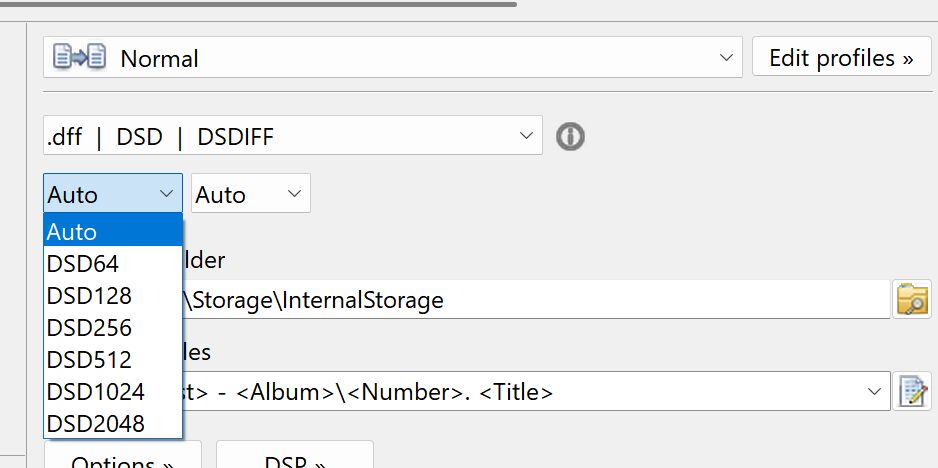
You’ll need to adjust the sample rates to downgrade the DSD level, as found in the following documentation, listed on the website.
8 kHz - 3072 kHz PCM, DSD64, DSD128, DSD256, DSD512, DSD1024, DSD2048
Here is a screenshot from the audio convertor tab:
Good luck!
worked like a charm - thank you! andrej