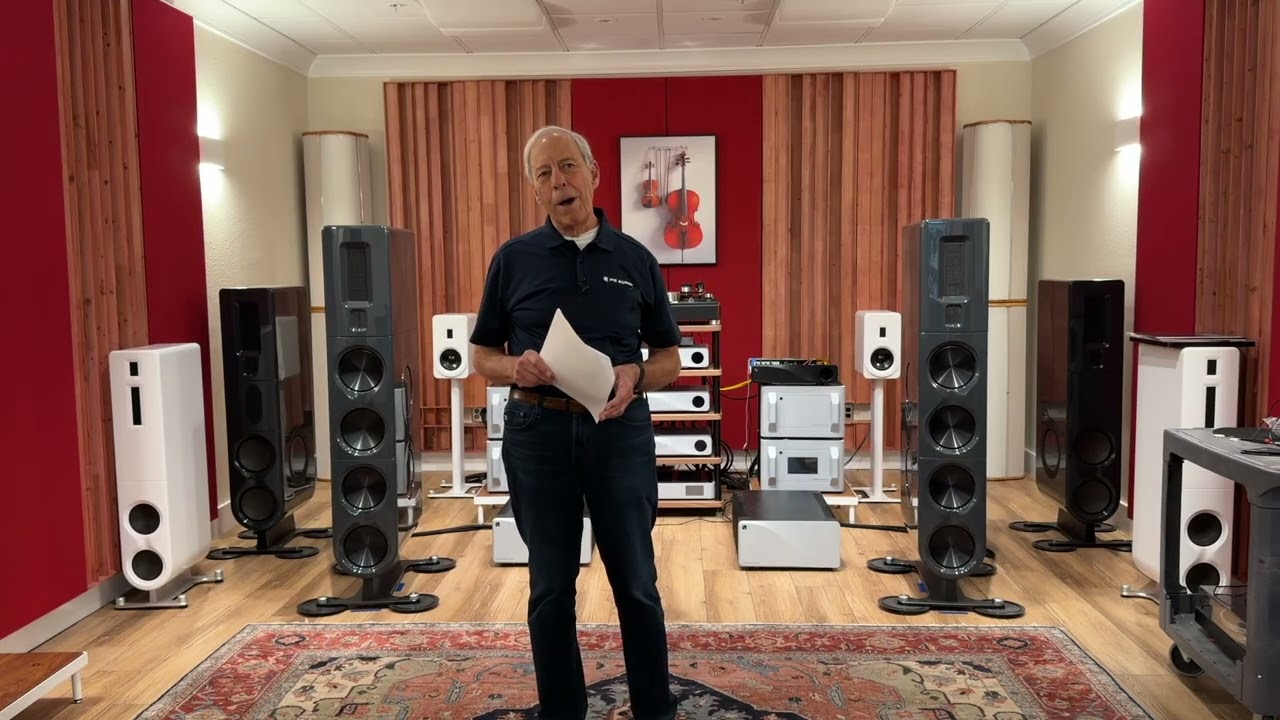
In his latest YT video (https://youtu.be/gDJQY37SEqY?is=GHweEoGCZMUUhCEo), Paul McGowan claims that **Maestro Music’**s sonic qualities stem from it being able to „leave the music untouched", like Qobuz (connect). And by leaving the music untouched, he means not tampering with the numeric information of the streamed files.
The way he presents this, and since he was mentioning Roon, Audirvana and JRiver prior to making his claim, he implicitly insinuates that the three named library management/playback software solutions do indeed NOT play back bit perfectly.
I was always under the impression that Roon does exactly that: stream bit perfect files, as long as I don’t engage MUSE DSP. Anyone with more insights into this topic?
This simply is how marketing works. Make claims without explanation, create FOMO and so on.
More of it and with at least a little bit of explanation what Paul was talking about here:
I think the biggest takeaway from this is that his app doesn’t seem to offer any DSP processing, a feature that can usually be turned off in players that offer it, so people have to stick with the original sound or have to add additional hardware if they need DSP (or use the DSP in their endpoint if any is offered there and the offering is sufficient). Bit-perfect obviously becomes irrelevant if one uses DSP processing.
Note: The majority of DAC’s use DSP internally anyway.
The sending a constant stream of data may be at least somewhat correct for the mentioned competition software but how is that relevant? The receiving device needs to re-clock the input anyway, using its own clock for that.
So where server based player software takes away as much work as possible from the endpoint so he can concentrate on sounding great, Paul says adding more work, like playback and potential DSP processing, to it is beneficial. If that would involve “costly” decryption though, I guess any of the big streaming services use encrypted streams (“copy protection”), his software is sending the data just as the competition does. If the “bursts” of data sent so the player can play from memory for a - little I guess - while (this is called buffering) makes a difference in sound is anyone’s guess (or beliefe).
mjw
(You want nice, supportive? Call a damn helpline.)
3
This is correct, and it is verifiable.
The topic was discussed at length over the summer until being derailed and closed.
I have the original PS Audio DirectStream DAC and the bit perfect test from PS Audio that you can run on it says Roon indeed can send a bit perfect stream.
That isn’t what he has been saying. His specific claim is that a recording played from a CD sounds different from the same recording from a streaming source, even when the DAC is receiving exactly the same bits. Then he claims to know the reason why, and to have created a fix for it. See what he says starting from 2:25 in this video:
Here is an explanation that he provides in the FAQ on the Maestro website. There are some things that remain murky and require more explanation. https://maestromusic.app/help
Why does Maestro sound better than other music apps?
Most audiophile software — Roon, JRiver, Audirvana — works by making your computer the player. When you press play, the server opens your music file, decodes it into raw audio samples, and streams its own output across the network to your DAC or streamer, continuously, for the length of the song. Your equipment never sees the original file; it receives the computer’s performance of it. The newer “Connect” services (Qobuz, Tidal) fixed half the problem — the streamer pulls directly from the cloud — but quietly created another: that means holding an encrypted TLS session and decrypting every frame of music in real time, on the small processor sitting inches from your DAC. Either way, something is working hard right next to your music.
Maestro is the only platform that solves both. When you press play, Maestro hands your streamer the address of the original file and gets out of the way — your equipment fetches it, buffers it deeply, and decodes it on its own clock, in the playback engine its designers voiced. And where the source requires encryption, Maestro’s LAN relay takes even that burden off your streamer: the computer quietly terminates the TLS session and serves the file over your home network as plain, untouched bytes — identical to the original, with your endpoint’s processor loafing instead of laboring. No software performing your music. No cryptography churning beside your DAC. The actual file that left the studio, played by the machine built to play it — which is why Maestro can run from just an iPad, and why nothing else sounds like it.
That’s not exactly an explanation, because (just as anything else Uncle Paul says) it makes absolutely no sense.
But then, if you remember 3 things:
Uncle Paul is there to sell you PS Audio products, not to help you.
He has absolutely no idea what he is talking about,
and he does not care either
and realize that this is just marketing, aimed at very a specific market segment, not any kind of technical fact. Expecting “Maestro” to sound any better (or even different) is very much like expecting that drinking a can of Red Bull would actually give you wings. Although the latter is slightly more probable.
5 Likes
mjw
(You want nice, supportive? Call a damn helpline.)
12
This…
…and this…
…are different words describing what is broadly the same thing. Roon uses RAAT (server/bridge) whereas Audirvana, Lyrion, JRiver, and Maestro use DLNA as server and renderer. In constrast, Roon typically serves (not sends) PCM whereas DLNA can serve PCM or the uncompressed file.
In all cases, the DAC controls timing, and receives the same PCM stream.
PS Audio hasn’t developed a new server/renderer solution. It is simply another player sitting on existing DLNA foundations.
It’s again rather a marketing gag, it’s not even a real claim. It’s about selling a “solution” for a problem that doesn’t exist. This is commonly called snake oil. And it may be a somehow new approach to extend this idea to software. At least not the worst idea in this realm
And he very likely knows exactly what he’s saying. His words are very well chosen to infect the clueless and wealthy ones while complying with legal regulations and avoiding legally false advertising.
That’s exactly how snake oil works. Though, it’s not their whole product line for sure but a part of it which is snake oil.
An additional aspect is the rather hidden/implicit claim other products from other companies would be inferior/worse.
Both aspects are treated separately regarding legal compliance. And as long as the wording, the context and (wanted) suggestion is all together legally fine, the company can do so.
That’s the fundamental base for successful selling and marketing snake oil. Since no company can afford being permanently sued.
And finally, reading the title of this thread, they already spread enough doubts in their videos to make some people raise such questions.
4 Likes
mjw
(You want nice, supportive? Call a damn helpline.)
16
How do you know this? If you say this is from a real technical basis please explain.
There is no technical basis for this. Indeed, recent experiments with Diretta proved this not be the case.
I do hope this is not an AI summary, although it looks very much like it to me. This is not permitted by the forum rules.
Paul posted some more information about Maestro’s architecture on the PS Audio forum. He was responding to some questions raised in a Maestro thread on the Audiophile Style forum.
Yep, this information always leads to one major aspect, it’s a UPnP/DLNA player handing over a link or a file (link) to the attached device.
So, from this regard absolutely nothing special or even unique, and nothing really new.
Keep in mind, Maestro is just providing the access to the audio source, it doesn’t “touch” the original stream/file at all. As a consequence the attached device is only able to play a source stream/file format that it natively supports via UPnP/DLNA. Don’t know exactly when the very first UPnP/DLNA players appeared…
Fair point — I was going off Maestro’s own description of how it works, not independent testing, so I can’t claim that as verified. And I didn’t know about the Diretta experiments — do you have a link? Genuinely curious, because if processor load near the DAC doesn’t measurably affect the output, that undercuts a lot of these “architecture” claims — including Maestro’s own marketing.
mjw
(You want nice, supportive? Call a damn helpline.)
20
See this;
mjw
(You want nice, supportive? Call a damn helpline.)
21
IIRC, the original Squeezebox2 with SlimServer (DLNA) decoded FLAC. Asalready mentioned, DLNA can stream PCM or serve the original file. So yes, nothing new. Roon / RAAT is unique in the way it distributes lossless music.
…contains a marketing contradiction anyway. What generates more work: decoding a file to extract PCM or receiving the PCM stream? Actually, it makes no difference because everything is unpacked and buffered before the DAC processes the data.